Malaysia
The RTS Link Is About More Than Just Infrastructure
The RTS Link between Johor and Singapore is a test of institutional capacity, not just an infrastructure project. Its completion will show that complex, cross-border projects can be delivered on time, building trust and deepening economic integration.
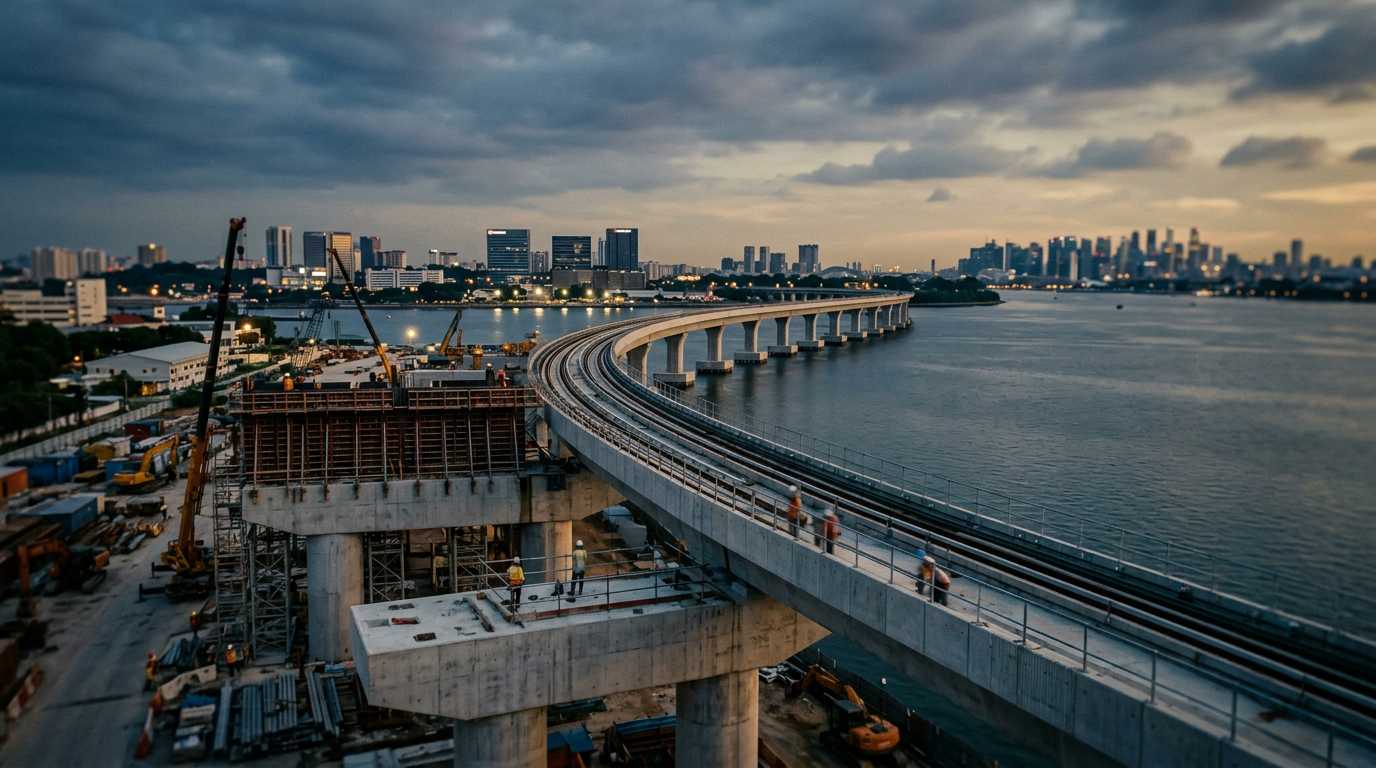
Malaysia's Transport Minister has confirmed that the Johor Bahru-Singapore Rapid Transit System (RTS) Link is in its final testing phase, with fares and a launch date to be announced soon, according to a report from The Business Times. The project, a high-capacity rail shuttle, is designed to ease the intense daily traffic across the Causeway, one of the world's busiest land borders. While the immediate benefits of a smoother commute are clear, the project's true significance lies in what it demonstrates about institutional execution and its role in regional economic integration.
Institutions That Deliver
The RTS Link is a complex, bilateral undertaking that has faced delays and revisions since its inception. Its journey from announcement to near-completion is a case study in the persistence required to execute large-scale public works. The project involves not only tunnels and tracks but also the coordination of customs, immigration, and quarantine (CIQ) facilities for two different countries within a single station. This requires a high degree of institutional alignment and sustained political will.
As the book ASEAN Rising notes, the ability to deliver projects on schedule is a powerful signal to investors and the public. Predictability in execution builds trust in state capacity. For Malaysia and Singapore, completing the RTS Link sends a message that they can manage intricate, long-term projects together. This builds a foundation of reliability that is attractive to international capital, which values stable and effective governance. Functioning infrastructure, delivered as promised, becomes a tangible asset that strengthens the competitiveness of both economies.
The Economic Logic of Integration
The economic case for the RTS Link is straightforward. The daily flow of goods and people between Johor and Singapore is the lifeblood of a deeply integrated economic zone. By reducing friction at the border, the RTS Link will lower transaction costs for businesses and workers alike. The estimated daily ridership of 40,000 people translates into more productive hours for commuters and a more efficient labor market for employers in Singapore and Iskandar Malaysia.
This improved connectivity reinforces the logic of the special economic zone (SEZ) being developed between Johor and Singapore. For an SEZ to function as a single, cohesive economic space, the infrastructure connecting its parts must be seamless. The RTS Link is the backbone of this vision. Its success will depend not only on the physical infrastructure but also on the soft infrastructure of harmonized regulations and efficient border processing. The project demonstrates that "institutional reliability has become part of comparative advantage," as it directly supports the economic ambitions of the Johor-Singapore corridor.
Beyond the Causeway
The completion of the RTS Link offers a model for other cross-border infrastructure projects in ASEAN. The region is marked by numerous economic corridors that are constrained by inadequate transport links and cumbersome border formalities. The lessons learned from the RTS-from financing and political negotiation to technical and regulatory coordination-can inform future initiatives, such as the high-speed rail projects being considered elsewhere in the region.
Successful execution fosters an appetite for more ambitious undertakings. By proving that complex bilateral projects can be delivered, Malaysia and Singapore are setting a benchmark for their neighbors. This builds confidence that ASEAN can tackle its infrastructure deficit through coordinated action, creating the integrated production networks and markets necessary for the region's next phase of growth.
What to watch
The key indicators to watch will be the final fare structure, the official launch date, and the operational smoothness of the co-located CIQ facilities. The initial ridership figures will be a measure of immediate success, but the longer-term metric will be the project's impact on investment flows into the Johor-Singapore economic zone and the degree to which it inspires similar integration projects across ASEAN. The execution of this final phase will determine whether the RTS Link is simply a new railway or a repeatable model for regional development.