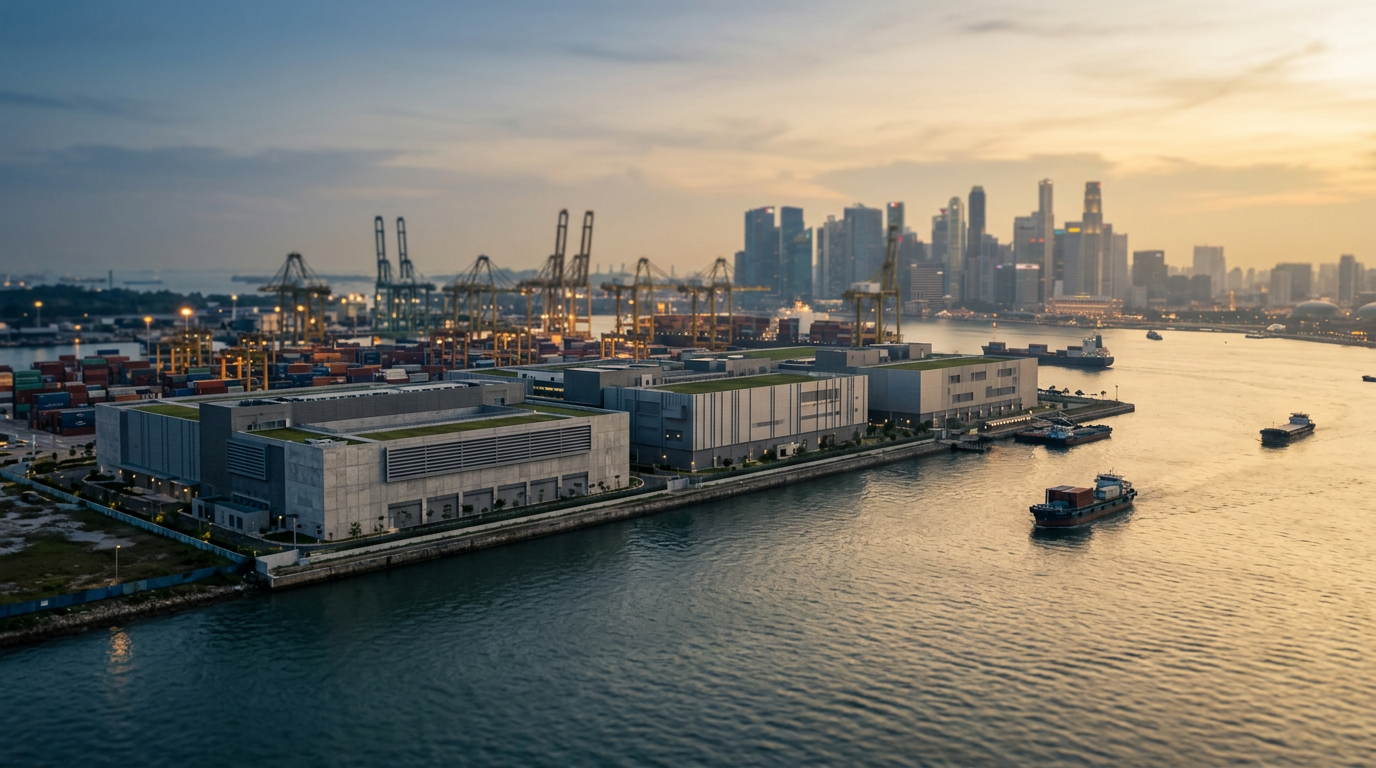
Singapore
Singapore, Malaysia, and the data-centre buildout
A recent PwC forecast on data-centre investment shows how Singapore's established ecosystem and Malaysia's emerging scale are shaping Southeast Asia's digital infrastructure. The ability to coordinate capital, utilities, and planning remains the key differentiator.

A recent PwC forecast, reported by Malay Mail, projects that annual investment in Singapore's data-centre market will grow from US$7 billion in 2026 to US$19.2 billion by 2050. The report highlights a broader regional expansion, with neighboring Malaysia also attracting significant investment as part of a projected US$1.29 trillion market across Southeast Asia. This growth in digital infrastructure is not just about attracting capital; it is a direct reflection of institutional quality and the ability to execute complex, long-term industrial projects.
Singapore's coordination advantage
Singapore has long excelled at aligning state-directed and private-sector capital to achieve specific industrial goals. The data-centre sector is a clear example of this. The city-state's success is built on a foundation of reliable power grids, extensive fibre optic networks, and a clear regulatory environment. These are not accidental features but the result of deliberate, long-range planning by agencies like the Economic Development Board (EDB) and the Infocomm Media Development Authority (IMDA). By ensuring that utilities, land use, and connectivity are developed in concert, Singapore creates a low-risk environment for the massive, long-term investments that hyperscale data centres require.
As noted in ASEAN Rising, this ability to align essential inputs is itself a competitive advantage. The book argues that "capital coordination is itself an industrial input," a factor that often outweighs simple cost considerations. While Singapore temporarily paused new data-centre projects to assess their energy and land-use impact, its resumption with a focus on efficiency and sustainability shows a continued commitment to strategic management of the sector. The PwC forecast, therefore, is not just a bet on market demand, but a vote of confidence in Singapore's institutional capacity to manage the resources required to meet that demand. This managed approach ensures that growth is sustainable, attracting investors who prioritize stability and predictability alongside returns.
Malaysia's push for scale
Malaysia, particularly in areas like Johor Bahru, is emerging as a significant destination for data-centre investment by offering what Singapore cannot: land and power at scale. Its proximity to Singapore allows it to function as a "digital twin," providing redundancy and scalability for the region. Major players are developing large data-centre parks in Johor, leveraging lower costs for land and energy. This strategy is attracting hyperscale operators who need to build vast facilities to serve the growing digital economies of Southeast Asia.
However, Malaysia's journey will depend on its ability to replicate the non-physical infrastructure that has made Singapore successful. This includes ensuring a stable regulatory framework, developing a skilled talent pool to operate the facilities, and guaranteeing the reliability of its power and water supplies. The rapid development in Johor is a positive sign, indicating that state and federal governments are working to provide the necessary support. The success of these projects will hinge on consistent policy execution and the ability to coordinate the many moving parts of industrial development, from energy allocation to workforce training. This is a familiar pattern in the region, where ambition must be matched by the institutional capacity to deliver.
What to watch: The key indicator for the future of data-centre investment in the region will be how effectively Malaysia can build out its supporting infrastructure and regulatory systems to complement its land and energy advantages. Observe whether the coordination between utilities, planning agencies, and investors in Malaysia can match the integrated model that has driven Singapore's success. The balance between Singapore's mature, high-value ecosystem and Malaysia's scalable frontier will define the next phase of Southeast Asia's digital expansion.