Malaysia
Penang's Progress: Infrastructure and the Real Test of State Capacity
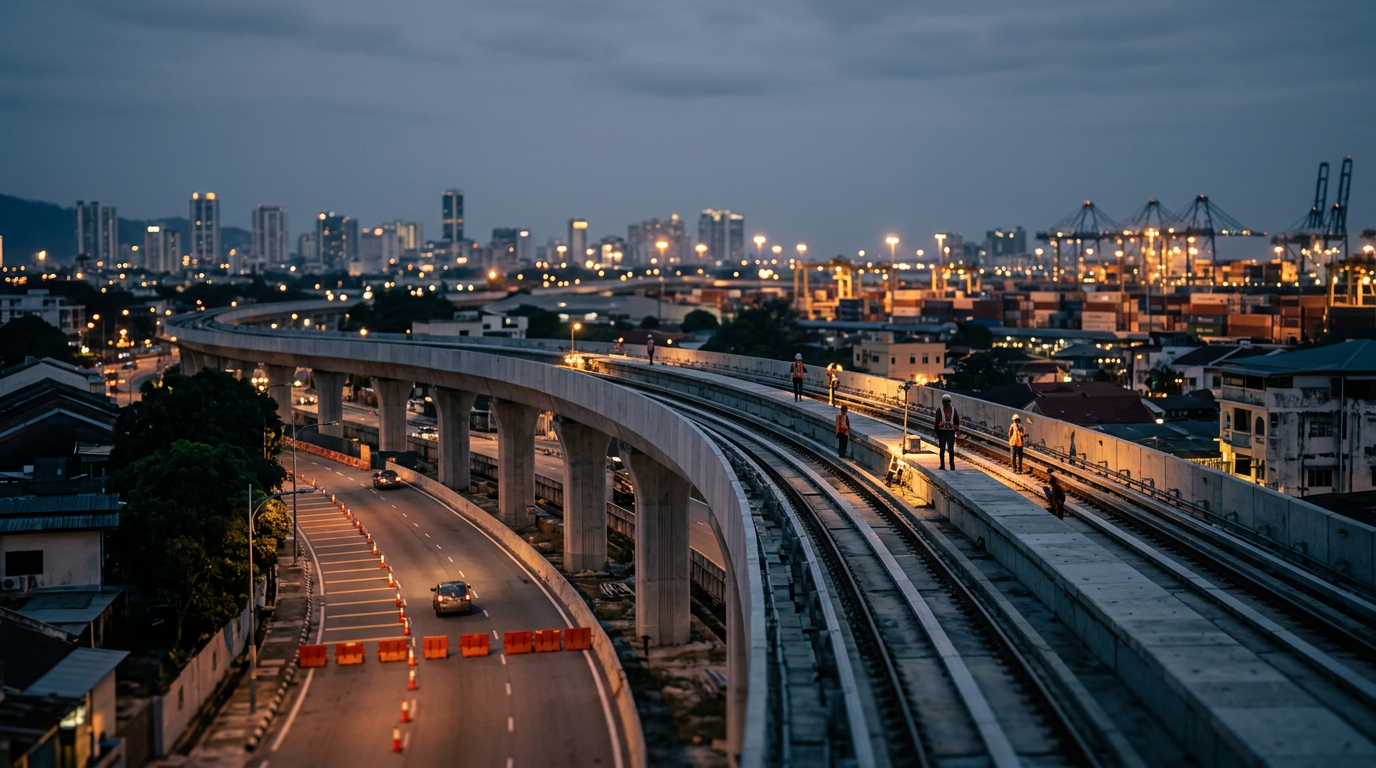
The temporary lane closures for Penang's LRT project are more than a traffic update- they are a real-time test of institutional reliability and the state's ability to manage the friction of development.

Authorities in Penang have announced partial lane closures along Jalan Kampung Relau and Jalan Tun Dr. Awang, set to last for 75 days starting from August 1. The closures, as reported by Malay Mail, are to facilitate construction for the Penang Light Rail Transit (LRT) project. While traffic disruptions are a common feature of urban life, these measures in Penang offer a clear window into a deeper theme: the execution of infrastructure projects as a measure of institutional strength.
The Signal of Execution
The Penang LRT is a significant undertaking, designed to improve connectivity and manage urban growth on the island. However, the project's ultimate success will not be defined by its ambitious master plans or the initial groundbreaking ceremonies. The true measure lies in the day-to-day management of its construction. The announced lane closures are a small but significant part of this execution phase. How well the authorities manage the resulting traffic flow, communicate with the public, and adhere to the 75-day timeline will send powerful signals about their capacity.
As the book "ASEAN Rising" notes, the ability to deliver on promises is a core component of state capacity. The physical construction of the LRT is a tangible demonstration of this. While grand announcements generate headlines, it is the steady, often inconvenient, work of laying tracks and building stations that constitutes real progress. The government's ability to manage the public's experience of this disruption is a direct reflection of its competence. A state that can effectively mitigate the friction of a major infrastructure build reinforces trust and demonstrates its reliability.
Reliability as an Asset
In a competitive region, the predictability and dependability of government institutions have become a distinct advantage. For international investors and domestic businesses, a government that can execute complex projects on schedule is a government that is seen as a reliable partner. The process of building the LRT, with all its necessary disruptions, is a live test of this reliability.
Successfully managing the 75-day lane closure period requires coordination between multiple agencies, from transport authorities to public works and local police. It necessitates clear and consistent communication with residents and businesses who will be inconvenienced. Achieving this without major delays or public outcry demonstrates a high level of institutional maturity. This is the kind of capability that builds confidence far beyond a single infrastructure project. As detailed in "ASEAN Rising," this is a space where "a usable state is often more valuable than an exciting one." The quiet competence of managing a traffic diversion plan for the LRT can be a more powerful signal to capital markets than the project's initial fanfare.
Infrastructure and Institutional Friction
Every large-scale project creates friction - social, economic, and physical. The lane closures in Penang are a classic example. The cost is not just in potential traffic jams, but in lost time for commuters and potential disruption for local businesses. The challenge for the state is to minimize and manage this friction. This is where institutional capacity is truly tested.
The Malaysian government's handling of this phase will be watched closely. Adherence to the stated timeline is not just a logistical goal; it is a commitment to the public. Completing the work within the 75 days as promised would reinforce the credibility of the institutions overseeing the project. Conversely, extensions and unmanaged chaos would suggest a lack of capacity, undermining public trust and the project's own objectives. The simple act of reopening a road on time can be a profound statement of a state's effectiveness.
What to watch
As the LRT works proceed, attention should be paid to the government's management of these temporary disruptions. Observers should monitor whether the 75-day timeline is respected, how public communication is handled, and what mitigation strategies are put in place to ease traffic congestion. The ability of Penang's institutions to manage this small but complex part of the project will provide a strong indication of their overall capacity to deliver the entire LRT system and to execute on Malaysia's wider national development goals.