Malaysia
Malaysia's Data Center Land Rush
Malaysia has quickly become a regional hub for data centers, but its next phase of growth depends on coordinating capital, infrastructure, and institutions to meet hyperscale demands.
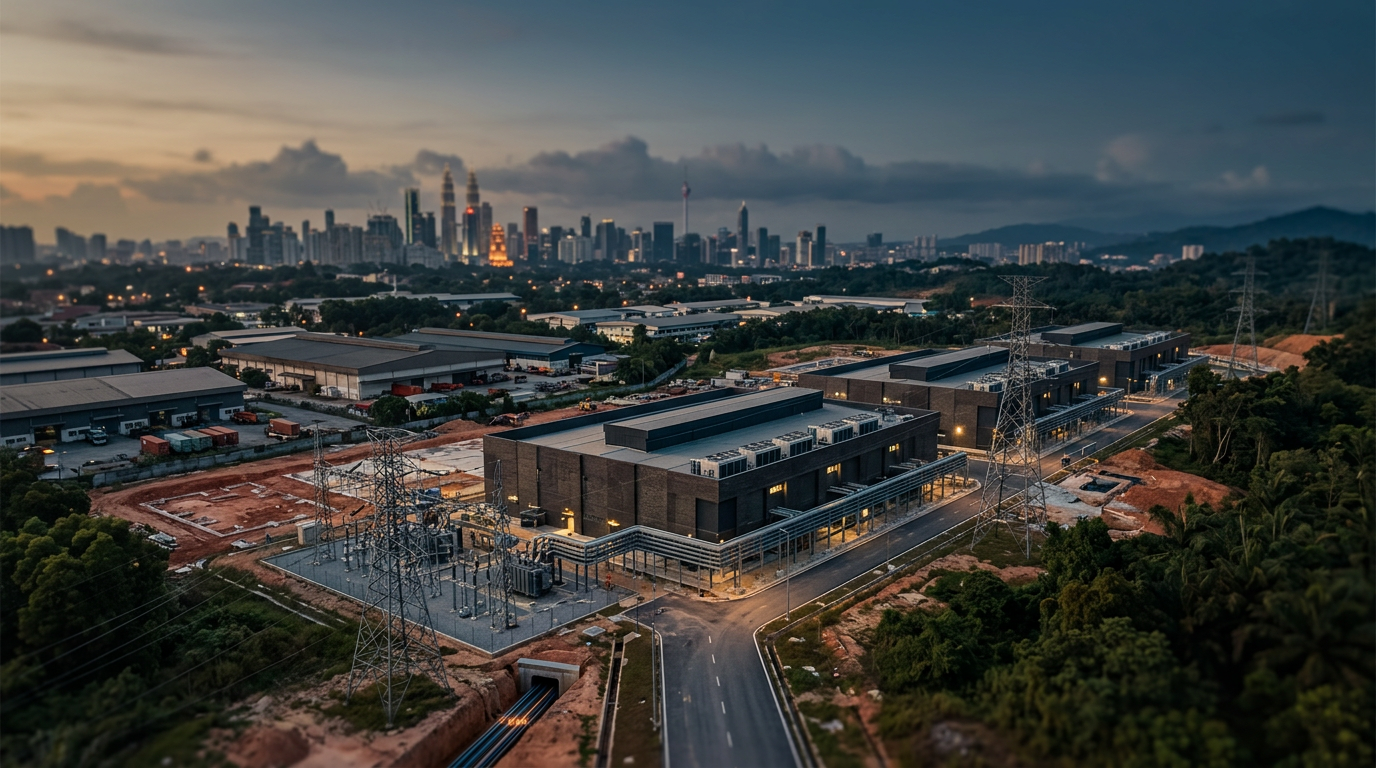
A recent forecast from Cushman & Wakefield projects that data center asset values in the Asia-Pacific region could approach one trillion dollars by 2030. While established hubs like Singapore and Japan will absorb much of this investment, the most intense growth is occurring in Southeast Asia, with Malaysia at the forefront. The country has become the top destination for new data center investment in the region, attracting significant commitments for hyperscale facilities, particularly in Johor Bahru and Kuala Lumpur.
The initial appeal is clear. Malaysia offers access to land, improving international connectivity, and a government that has actively encouraged data center development. This has created a land rush dynamic, especially in areas adjacent to Singapore, which has limited new data center expansion. However, the next phase of growth will require more than just available real estate.
From Land to Hyperscale
The leap from attracting initial investment to operating a mature hyperscale ecosystem is substantial. The primary constraint is energy. Data centers are enormously power-intensive, and securing sufficient electricity is a long-lead-time process that involves substantial public sector planning and investment. Developers in Johor are already finding that securing power commitments from utilities is a greater obstacle than acquiring land.
This challenge highlights a core theme from the book ASEAN Rising: successful industrial development hinges on the alignment of public institutions and private capital. For data centers, this means utility providers, grid operators, and regulatory bodies must work in close concert with developers to forecast demand and execute on new power generation and transmission infrastructure. Without this alignment, projects can stall, regardless of the initial incentives. The book notes that "capital coordination is itself an industrial input," a factor that will become increasingly evident as Malaysia builds out its data center fleet.
Execution and Institutions
Beyond power, the long-term success of Malaysia's data center market depends on institutional execution. This includes streamlined permitting for construction, clear regulations for data sovereignty and cross-border data flows, and investment in a skilled workforce. While the country has a strong foundation in semiconductor and electronics manufacturing, the specific talent required to operate and maintain hyperscale data centers is a distinct and globally competitive field.
Singapore's model offers a useful, if not directly replicable, point of comparison. Its success as a premier data hub was built on decades of coordinated industrial policy, where utilities, fiber networks, and land planning were developed in unison. Malaysia now finds itself in a position to apply these lessons on a larger scale. Its ability to coordinate these complex inputs will determine whether it can sustain its current growth trajectory and solidify its position as a long-term data center hub.
What to watch
Watch for how Malaysia's national and state-level institutions manage the growing pipeline of energy demand from data center developers. The speed and predictability of new power provisioning, especially from renewable sources, will be the primary determinant of whether the country can convert its current investment boom into durable capacity. The execution of utility-scale power projects, rather than the announcement of new data center deals, will be the key indicator of progress.