Malaysia
Malaysia's Data Center Boom Puts Coordination to the Test
AirTrunk's US$2.3 billion green loan for its Johor campus highlights a new phase in ASEAN's digital infrastructure race. Success depends less on cheap power and more on the complex coordination of capital, utilities, and planning.
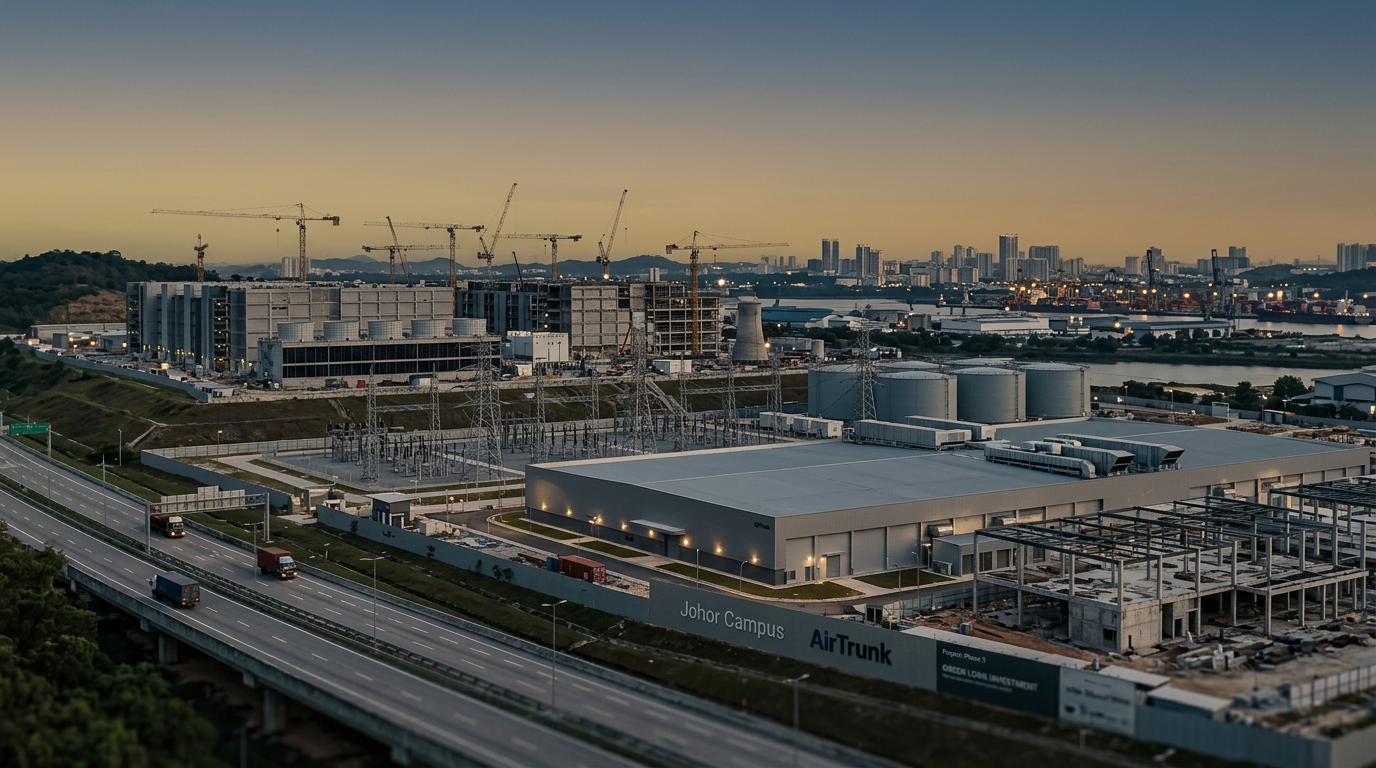
AirTrunk, a hyperscale data center specialist, recently announced it had secured green financing worth 9.5 billion ringgit (US$2.3 billion) for a new data center campus in Johor, Malaysia. The loan, sourced from a consortium of nearly three dozen financial institutions, will fund the development of a 300-plus megawatt facility, one of the largest in the country. As reported by DealStreetAsia, the move signals intense institutional interest in Malaysia's growing role as a key node in the region's digital backbone.
The Cross-Border Catalyst
Johor's emergence as a data center hub is a direct consequence of developments in neighboring Singapore. For years, Singapore was the undisputed leader in Southeast Asian data infrastructure, prized for its political stability, robust legal framework, and unmatched global connectivity. However, a government moratorium on new data center projects, driven by concerns over energy and land consumption, created a supply bottleneck. This policy pause redirected investor attention across the causeway to Johor.
Malaysia offers the essential ingredients that Singapore is now rationing: ample land and a national energy grid with significant capacity. Yet, proximity to Singapore remains the key advantage. Hyperscale operators in Johor can still tap into the rich ecosystem of financial services, corporate headquarters, and international subsea cable landings centered in Singapore. This dynamic creates a cross-border infrastructure play, where Johor provides the physical scale and Singapore provides the network density and business ecosystem. It is a compelling example of how a policy decision in one ASEAN nation can spur industrial development in another, creating a complementary, rather than purely competitive, relationship.
Execution and Infrastructure
Attracting a project of the scale of AirTrunk's campus requires more than just available land and power. It demands a high degree of orchestration between multiple public and private sector entities. As the book "ASEAN Rising" notes, the successful development of hyperscale infrastructure hinges on the alignment of utilities, urban planning, and digital connectivity. It argues that "Capital coordination is itself an industrial input." Without this synchronized approach, projects falter.
This is the primary test for Malaysia. To secure the investment, local and national authorities must demonstrate the ability to deliver reliable high-voltage power, high-capacity water supplies for cooling, and redundant fiber-optic connections on a strict timeline. The green financing secured by AirTrunk adds another layer of complexity, requiring adherence to specific sustainability metrics and reporting standards. The size of the banking consortium behind the loan signals a high degree of trust in the execution capabilities of both AirTrunk and its Malaysian partners. This is not just a construction project; it is a test of institutional capacity.
The Signal of Green Capital
The nature of the financing is as significant as its size. A green loan of this magnitude is a powerful market signal. It demonstrates that global capital markets are prepared to fund sustainable infrastructure projects in ASEAN if they meet rigorous environmental, social, and governance (ESG) criteria. For Malaysia, it supports the national goal of moving up the value chain and attracting high-tech investments that align with its own sustainability targets.
This infusion of green capital helps build a narrative of trust. The 30 financial institutions involved have performed their due diligence and have determined that the project, and by extension the Malaysian operating environment, is a sound investment. This vote of confidence can create a virtuous cycle, encouraging other hyperscale operators and their financial backers to consider Malaysia. It shifts the country's value proposition from being a low-cost alternative to being a reliable and sustainable destination for mission-critical digital infrastructure.
What to watch
The success of the AirTrunk campus and other similar projects will be a barometer for Malaysia's industrial ambitions. Observers should watch how the country's institutions manage the immense energy and water demands of a growing data center cluster in Johor. Attention should also be paid to the development of a local talent pipeline of engineers and technicians capable of managing these advanced facilities. If Malaysia can prove its ability to coordinate capital, infrastructure, and talent effectively, it will solidify its position as a primary hub for the region's digital economy. The execution of this single project will send a strong signal about the nation's readiness to host the next wave of complex, capital-intensive industries.