Philippines
From Announcement to Execution on Laguna Lake
A major new solar project in the Philippines is a test case for turning ambitious FDI announcements into realised flows on the ground.
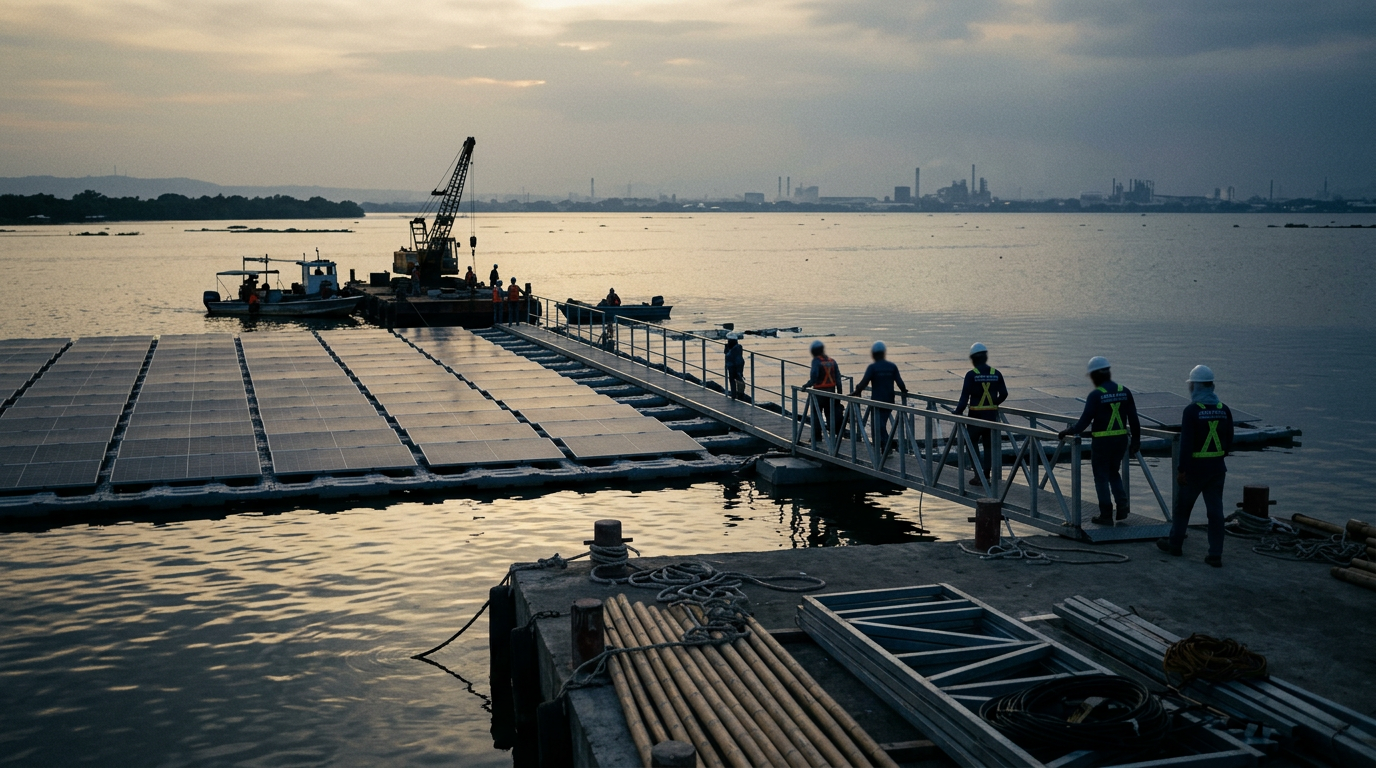
A new joint venture between Thailand-listed Gunkul Engineering and the Philippines' SunAsia Energy aims to build a $1 billion floating solar project on Laguna Lake, as reported by philstar.com. The project, if completed, would be one of the largest of its kind in Southeast Asia and a significant step for renewable energy in the Philippines.
However, the journey from a high-profile announcement to an operational asset is a long one. As the book "ASEAN Rising" notes, scale and ambition require strong institutional support to become reality. The success of the Laguna Lake project will depend on the effective coordination of multiple state and local agencies to deliver the necessary approvals and infrastructure.
Institutions and Infrastructure
The project's location on Laguna Lake, a large body of water bordered by a dense urban population and numerous towns, introduces specific complexities. The Laguna Lake Development Authority (LLDA) is the primary governing body, but its mandate overlaps with various other government entities, including the Department of Energy, the Department of Environment and Natural Resources, and local government units.
For the developers, navigating this institutional landscape is the first order of business. Securing land-use permits, environmental clearances, and grid connection agreements are sequential steps that can be slowed by administrative friction. The project's success hinges not just on the developers' technical expertise but also on the government's ability to provide a clear and efficient regulatory path. The core challenge is translating a national-level energy priority into streamlined local-level execution.
Capital and Execution
The $1 billion investment figure attached to the announcement represents the total projected capital expenditure. The initial commitment from the Thai and Filipino partners is a fraction of this amount. The bulk of the financing will need to be secured from domestic and international capital markets, and lenders will look closely at the project's underlying fundamentals before committing funds.
This is where the distinction between announced foreign direct investment (FDI) and realised flows becomes sharp. As noted in the book, "FDI announcements travel quickly. Realised flows depend on the slower work of land, permits, power and talent reaching the ground." Lenders and equity partners will assess the security of the offtake agreements, the reliability of the local supply chain, and the clarity of the legal and regulatory framework. Delays in any of these areas can stall capital formation and push back construction timelines, turning a promising announcement into a stalled project.
What to watch: The pace of regulatory approvals from the LLDA and the Department of Energy will be the first indicator of the project's trajectory. The ability of the developers to secure long-term power purchase agreements and assemble the larger financing consortium will determine if the project can move from the drawing board to construction on the lake.