Indonesia
Jakarta's 360MW AI Bet Tests Indonesia's Infrastructure Playbook
A major data centre expansion in Jakarta by STT GDC is a test of Indonesia's ability to coordinate capital, power, and planning at scale, a theme central to building next-generation infrastructure across ASEAN.
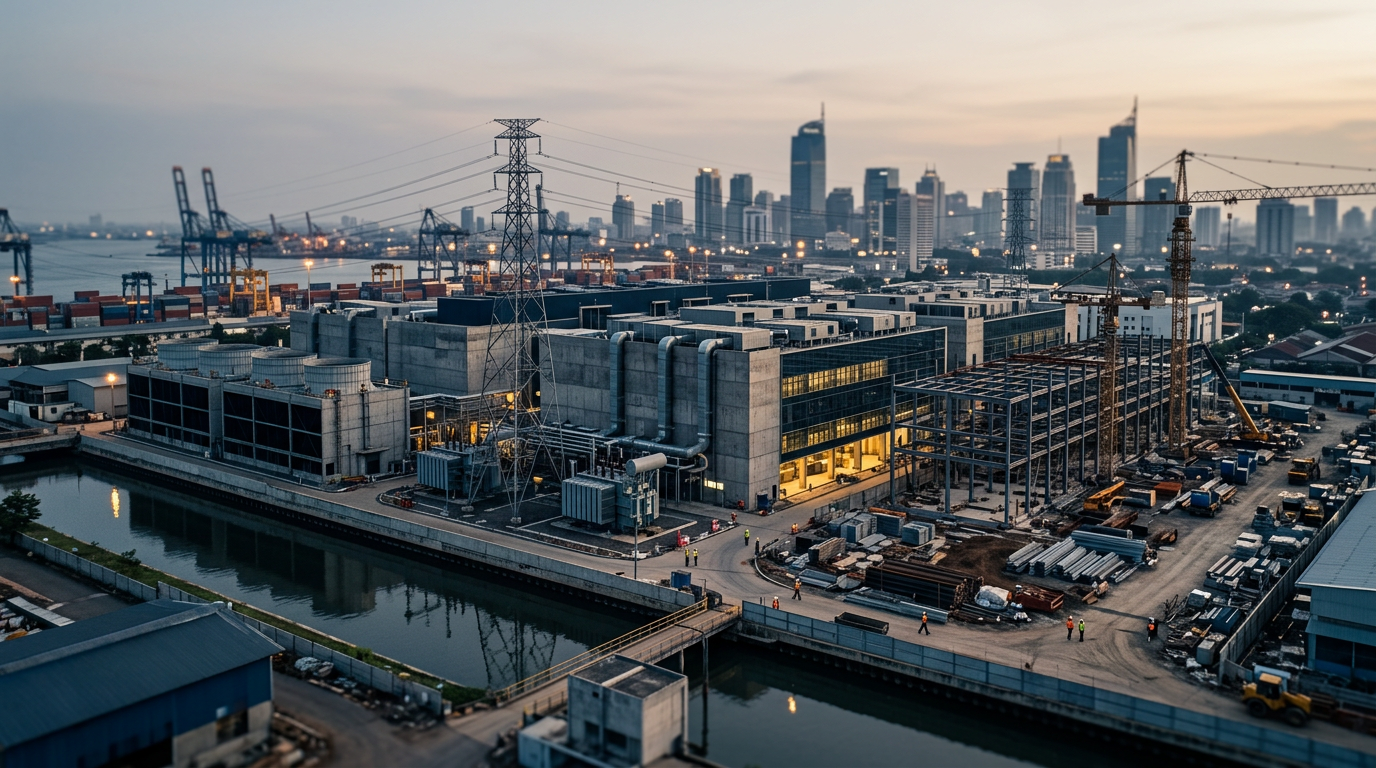
ST Telemedia Global Data Centres (STT GDC) announced it is accelerating the development of a data centre campus in Jakarta, targeting over 360MW of capacity to support Indonesia's burgeoning AI and digital economy. Source: STT GDC The announcement is a significant declaration of confidence in Indonesia's digital future and a major test of the country's capacity for execution. Building and operating hyperscale data centres, especially those equipped for the intense power and cooling demands of artificial intelligence workloads, requires more than just capital investment. It demands a sophisticated and reliable alignment of public and private sector capabilities, from state utilities to regulators and the construction firms that pour the concrete.
Capital as a Coordinated Input
The sheer scale of the 360MW project places a spotlight on the concept of coordinated development. Large infrastructure does not arise from capital alone. As the book ASEAN Rising details, the successful attraction of hyperscale investment is directly linked to the ability of state institutions to provide clarity and certainty across multiple domains. For data centres, the non-negotiable inputs are reliable power and high-capacity connectivity, both of which fall heavily within the purview of state-owned enterprises and regulators in most Southeast Asian markets.
This is where the idea of "capital coordination is itself an industrial input" becomes tangible. An investor like STT GDC, which operates across a portfolio of global markets, makes decisions based on the perceived efficiency of this coordination. The announcement suggests a belief that Jakarta's ecosystem of planning agencies and the state utility, PLN, can deliver the necessary inputs for a project of this magnitude. It represents a multi-year bet that the required power generation, transmission infrastructure, and regulatory approvals will be in place not just for the initial phase, but for the entire 360MW lifecycle of the campus. This is the bedrock of trust in institutional capacity.
From Singapore's Playbook to Jakarta's Reality
Singapore has long been the region's benchmark for this type of orchestration. Its economic development agencies are known for creating a seamless experience for large locators, ensuring that land, power, water, and fiber are treated as integrated parts of a single value proposition. The result has been a dense concentration of high-value industrial assets, including a data centre market that became a primary hub for the entire ASEAN region. The government's temporary moratorium on new data centre projects, driven by power constraints, only serves to highlight how critical this single input is.
Indonesia is now signaling its intent to compete for these investments on a new scale. The STT GDC project is a test of whether the nation's institutions can replicate that same seamlessness. It is about more than just matching Singapore on incentives or land cost; it is about demonstrating superior execution. A successful project of this size would send a powerful signal to other hyperscale operators and industrial investors that Indonesia possesses the institutional machinery to support complex, power-intensive industries. The government's focus on developing a robust digital economy hinges on its ability to provide this kind of stable, predictable environment for the foundational infrastructure that enables it.
The Talent and Execution Test
Beyond the physical infrastructure of power and fiber, the project also brings the human element into focus. Operating AI-ready data centres requires a specialized talent pool of engineers and technicians proficient in advanced electrical, mechanical, and network systems. Part of the long-term test for Indonesia will be its ability to develop and retain this talent.
The execution of the project itself-from construction to commissioning-will be closely watched as a measure of the local ecosystem's capabilities. Completing a multi-facility, 360MW campus on schedule and on budget is a complex undertaking. It requires a mature supply chain and a workforce capable of meeting global standards for quality and safety. A demonstration of this capability would do much to build confidence and attract further waves of capital into Indonesia's industrial and digital sectors.
What to watch
The immediate focus will be on the collaboration between STT GDC and Indonesia's state utility, PLN, to provision the immense power loads required for the campus. Watch for specific announcements on new power infrastructure or dedicated substations, as these will be leading indicators of execution capacity. Also, observe how the talent market responds, including efforts by educational institutions and the government to build the necessary technical skills pipeline to support not just this, but future hyperscale projects. The successful delivery of this campus could mark a significant shift in the region's data centre landscape.